Understanding MSME ZED Assessment Parameters
A practical guide to how MSMEs are evaluated under the MSME Sustainable (ZED) Certification Scheme—and why the assessment framework is designed to drive continuous business improvement rather than merely award a certification.
Why Understanding the Assessment Framework Matters
For many Micro, Small and Medium Enterprises (MSMEs), ZED Certification is often perceived as another compliance requirement. In reality, the MSME Sustainable (ZED) Certification Scheme provides a structured roadmap for improving quality, productivity, operational excellence, environmental responsibility and long-term competitiveness.
Rather than evaluating businesses through a single inspection, the framework measures performance across multiple operational parameters that collectively reflect the maturity of an enterprise. This staged approach encourages organisations to strengthen their internal systems progressively while creating measurable business value.
Understanding these assessment parameters before beginning the certification journey enables businesses to identify improvement opportunities, prioritise investments and prepare more effectively for evaluation.
How the ZED Assessment is Structured
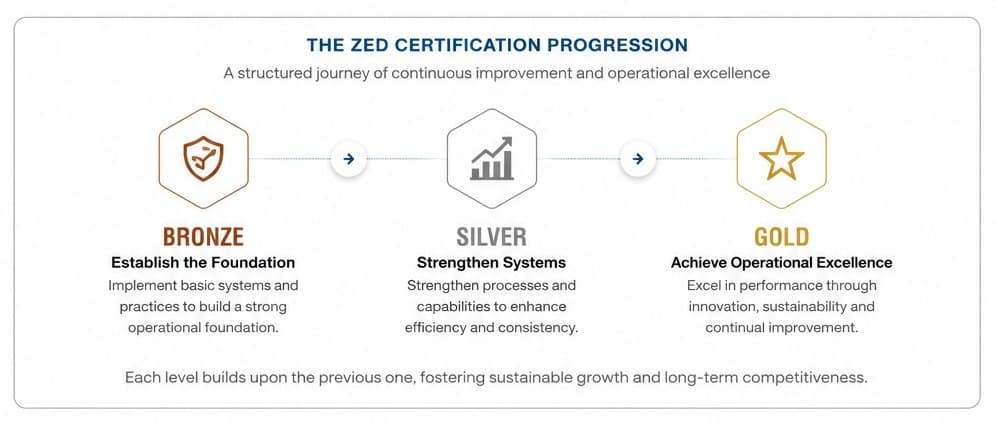
Figure 1: The progressive structure of MSME Sustainable (ZED) Certification.
Source: JSR Integricorp (Illustrative representation of the ZED Certification progression)
The ZED Certification framework is organised into three progressive certification levels: Bronze, Silver and Gold.Each level builds upon the previous one, encouraging continuous improvement instead of one-time compliance.
Businesses are evaluated across several operational domains including quality management, production systems, environmental practices, energy efficiency, safety, customer focus, human resource development and continual improvement. As organisations move from Bronze to Silver and eventually Gold, both the scope and the maturity expected under each assessment parameter increase.
The framework recognises that every MSME begins its journey from a different starting point. Rather than expecting every MSME to begin at the same level of maturity, the framework provides a structured pathway through which enterprises progressively strengthen their operational capabilities while demonstrating measurable improvement.
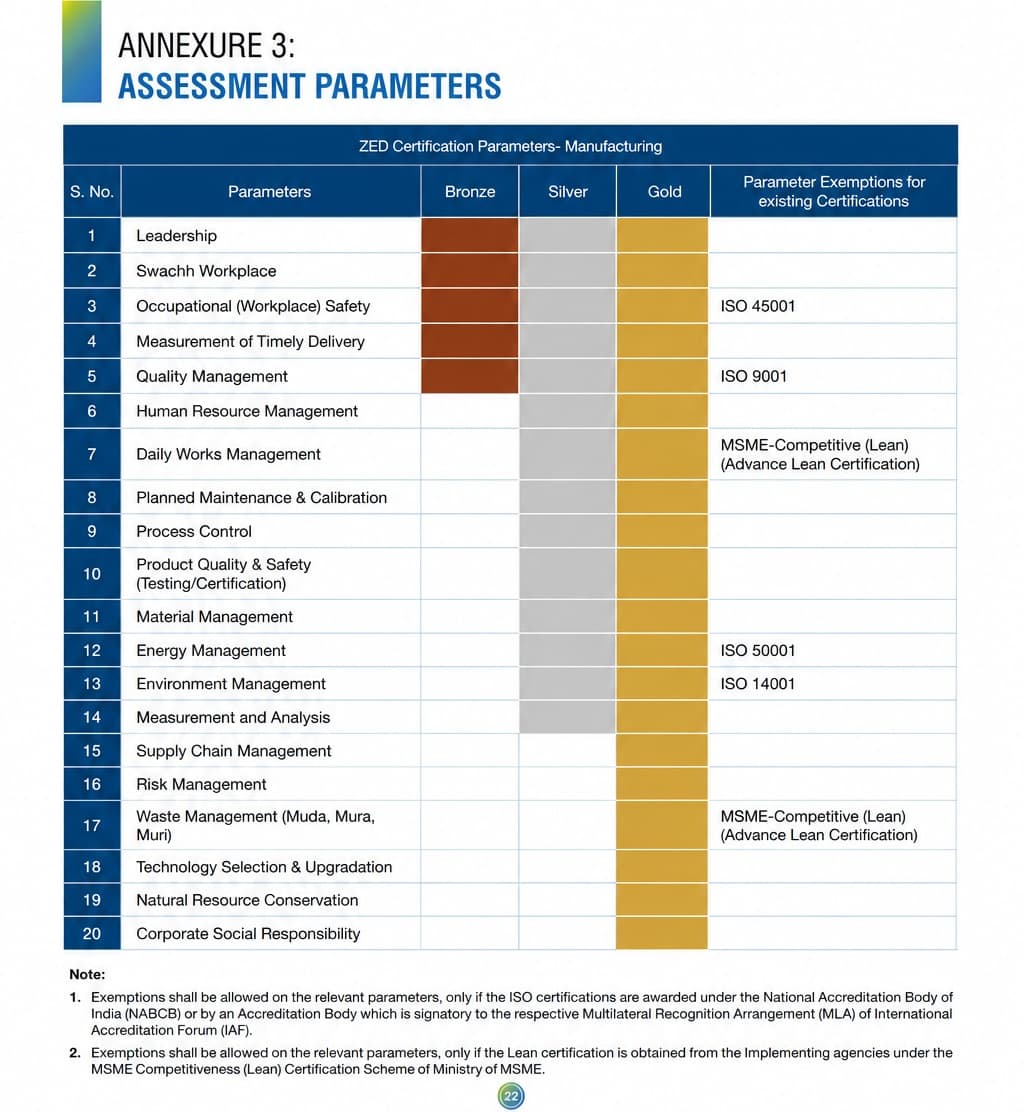
Figure 2: Assessment parameters across Bronze, Silver and Gold certification levels under the MSME Sustainable (ZED) Certification Scheme.
Source: Annexure 3, Guideline Book, MSME Sustainable (ZED) Certification Scheme, Ministry of MSME, Government of India.
Reading the Assessment Matrix
At first glance, the assessment matrix may appear overwhelming. However, its structure is straightforward once understood.
Each row represents a specific assessment parameter, while the three certification columns indicate the level of implementation expected for Bronze, Silver and Gold. Several parameters also recognise certifications or management systems already implemented by the enterprise, reducing duplication of effort where applicable.
It is important to note that progression through the certification levels is cumulative. Practices expected at the Bronze level continue to remain relevant as an organisation advances towards Silver and Gold, where additional requirements reflect higher levels of operational maturity.
In the following sections, we examine what distinguishes each certification level and how businesses can approach their improvement journey systematically.
Bronze Certification – Building the Foundation
Bronze Certification is the entry point into the ZED journey. Rather than expecting sophisticated management systems, it focuses on establishing disciplined business practices that create a reliable operational foundation.
At this stage, MSMEs are expected to demonstrate structured approaches towards quality, production planning, workplace organisation, customer focus, environmental responsibility and basic statutory compliance. The emphasis is on ensuring that essential business processes are documented, consistently followed and capable of supporting future growth.
For many enterprises, Bronze Certification represents the first opportunity to systematically evaluate existing practices against nationally recognised performance standards.
Business Perspective
Bronze Certification should not be viewed as the minimum certification level—it is the stage where businesses establish operational discipline. Organisations that invest time in strengthening these fundamentals often experience improvements in consistency, productivity and customer confidence even before progressing further.
Silver Certification – Strengthening Organisational Systems
Silver Certification builds upon the operational foundation established during Bronze by encouraging greater integration between business processes, performance measurement and continual improvement.
Businesses are expected to demonstrate stronger process controls, greater consistency in implementation and improved management oversight across multiple operational areas. Environmental management, resource efficiency, employee development and structured monitoring become increasingly important at this stage.
Rather than introducing entirely new concepts, Silver Certification expects organisations to mature the systems they have already implemented, ensuring that improvements become sustainable and repeatable throughout the enterprise.
Business Perspective
Organisations achieving Silver Certification are generally moving beyond compliance towards operational excellence. Better documentation, improved measurement and stronger management systems often result in greater efficiency and enhanced business resilience.
Gold Certification – Achieving Operational Excellence
Gold Certification represents the highest level of maturity within the MSME Sustainable (ZED) Certification framework. At this stage, operational excellence is expected to become part of the organisation's culture rather than an isolated improvement initiative.
Assessment focuses on leadership commitment, innovation, risk management, sustainability, resource optimisation, customer satisfaction and continuous organisational learning. Businesses are expected to demonstrate that improvement activities are embedded across the enterprise and consistently deliver measurable outcomes.
Gold Certification reflects a business that continuously evaluates its own performance, identifies opportunities for improvement and systematically adapts to changing market expectations.
Business Perspective
Gold Certification should be regarded as a milestone rather than the destination. The objective of the ZED framework is continual improvement, ensuring that businesses remain competitive, resilient and future-ready as technologies, markets and customer expectations evolve.
Recognition of Existing Certifications
One of the strengths of the ZED framework is that it recognises several internationally accepted management systems and certifications already implemented by MSMEs. This reduces duplication of effort and acknowledges investments businesses may have previously made towards quality, environmental management, safety or operational excellence.
Depending on the assessment parameter, certifications such as ISO 9001, ISO 14001, ISO 45001, ISO 50001 and the MSME Competitive (Lean) Scheme may satisfy or partially satisfy specific evaluation requirements under the ZED framework.
| Existing Certification | Assessment Area |
|---|---|
| ISO 9001 | Quality Management |
| ISO 14001 | Environmental Management |
| ISO 45001 | Occupational Health & Safety |
| ISO 50001 | Energy Management |
| MSME Competitive (Lean) | Daily Work Management & Lean Practices |
A Progressive Journey Rather Than Three Independent Certifications
It is important to understand that Bronze, Silver and Gold are not separate certification programmes. They represent successive stages within a single improvement journey, with each level building upon the capabilities developed during the previous stage.
Businesses should therefore focus on strengthening their operational systems rather than merely achieving the next certification level. Organisations that adopt this mindset generally derive significantly greater long-term value from the ZED framework than those pursuing certification solely for recognition.
Where Should Your Business Begin?
Every MSME begins its ZED journey from a different stage of operational maturity. Some organisations already have established quality systems and documented processes, while others are taking their first structured steps towards operational excellence. The objective is not to compare businesses but to identify the most appropriate starting point for continuous improvement.
Before applying for certification, businesses should develop a clear understanding of their current practices, identify areas requiring attention and prepare an implementation roadmap. A structured assessment before formal evaluation often helps organisations avoid unnecessary delays while focusing resources on improvements that deliver lasting business value.
The most successful ZED implementations are those in which certification becomes the outcome of genuine operational improvement rather than the sole objective. Businesses that embrace this philosophy typically realise benefits extending well beyond certification itself, including improved productivity, reduced waste, stronger customer confidence and greater organisational resilience.
In the Next Article
This article provides an overview of the complete assessment framework. In the next article, we will examine each Bronze Certification assessment parameter individually, explain what assessors typically look for and discuss practical measures MSMEs can implement before applying for certification.
Final Thoughts
The MSME Sustainable Zero Defect Zero Effect (ZED) Certification Scheme is far more than a certification programme. It is a structured methodology that encourages businesses to strengthen operational systems, improve sustainability, enhance quality and build long-term competitiveness through continuous improvement.
Whether an organisation is preparing for Bronze Certification or progressing towards Silver and Gold, understanding the assessment framework is the first step towards making informed business decisions. Certification should be viewed not as the destination, but as evidence of an enterprise's commitment to operational excellence.
At JSR Integricorp, we believe that lasting business transformation is achieved when structured methodologies are combined with practical implementation support. The ZED framework provides an excellent foundation for that journey.
References
Image Attribution: The assessment matrix reproduced in this article is adapted from Annexure 3 – Guideline Book, MSME Sustainable (ZED) Certification Scheme, published by the Ministry of Micro, Small and Medium Enterprises, Government of India. The original publication remains the authoritative reference.
Preparing for MSME ZED Certification?
A structured readiness assessment helps identify your current level of maturity, prioritise improvement opportunities and develop a practical roadmap towards successful ZED Certification.
Explore MSME ZED Certification ServicesDisclaimer
This article is intended for general educational and informational purposes only. While every effort has been made to present accurate information based on the official MSME Sustainable (ZED) Certification Scheme guidelines available at the time of writing, certification requirements, assessment parameters, subsidies and implementation procedures may be revised by the Ministry of MSME or other competent authorities without prior notice.
Readers are encouraged to refer to the latest official notifications, scheme guidelines and circulars before making business decisions. Nothing contained in this article should be construed as legal, financial or certification advice.
JSR Integricorp provides implementation support, advisory and assessment assistance based on the latest available official information and the specific circumstances of each enterprise.